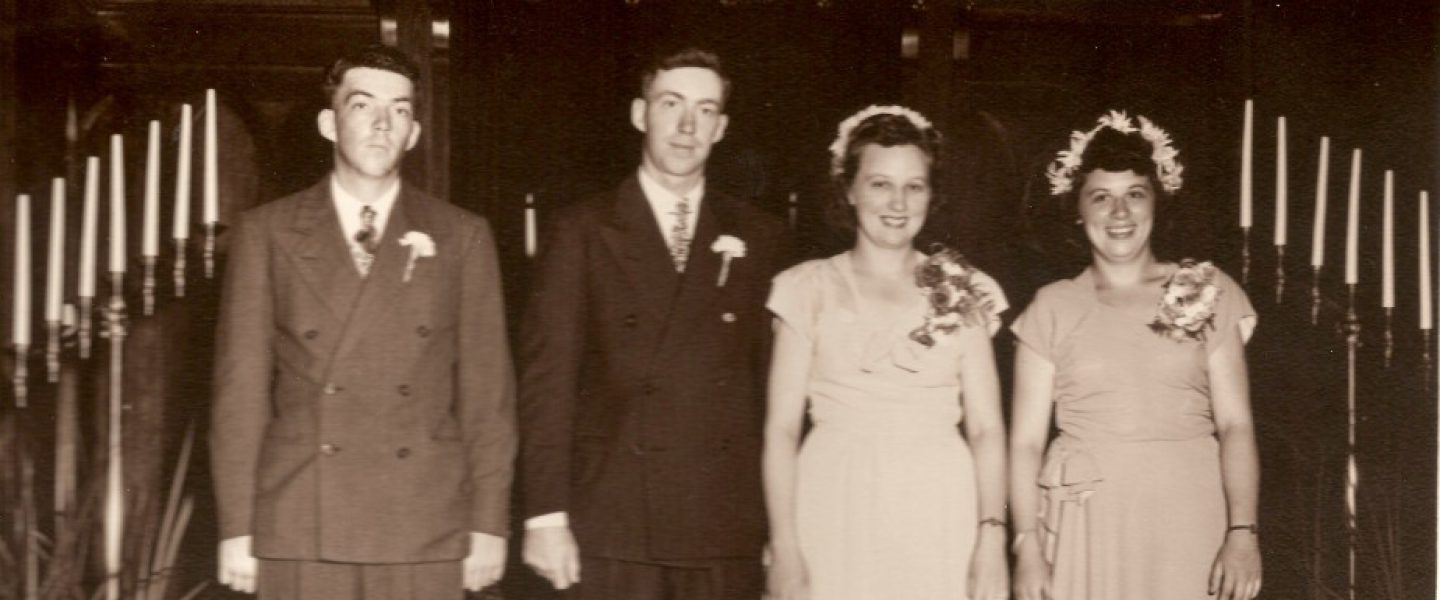

Meet my only Revolutionary War ancestor! Only one of my direct ancestors served in the Revolutionary War, and he is my 6th great-grandfather. Abijah Drake was born in Massachusetts in 1733 or 1734, and his parentage is not definitively proven. He lived in Taunton, Massachusetts, and on August 4, 1760, he married Tabatha Plumley. They would have four sons and one daughter together.
Abijah was living in Sutton, Massachusetts, at the start of the American Revolution. Less than a month after the battles of Lexington and Concord, Massachusetts was rapidly raising troops to besiege British forces in Boston. On May 17, 1775, Abijah answered that call and enlisted as a private in Capt. Edward Seagrave’s company in Col. Joseph Read’s (20th) regiment. Colonel Read’s regiment was part of the Massachusetts army surrounding Boston during the Siege of Boston in 1775. Abijah immediately joined other militia soldiers near Boston that summer. Capt. Seagrave’s company appears to have been stationed at Roxbury during June 1775, including on the day of the Battle of Bunker Hill nearby. Although Abijah was in the area and was serving in the army during the Battle of Bunker Hill, I have not found evidence that his company participated directly in the fighting. At Roxbury, he may have been involved in the construction of fortifications, digging trenches, guard duty, drills, and overall guarding the southern approach to Boston.


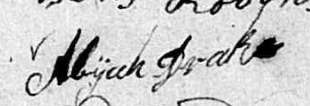
Abijah was named on the muster roll dated August 1, 1775, having served 2 months and 20 days. He was listed on the company return on September 25, 1775 and awarded a bounty coat or its equivalent in cash on December 21, 1775. Abijah Drake was one of the soldiers who authorized Sgt. Benjamin Pike to collect the money for his bounty coat in Roxbury. I believe his original signature is on the document! No further military records for Abijah have been identified after December 1775. He may have left military service when the 1775 Massachusetts army was reorganized into the Continental Army in 1776, although the surviving records do not document his discharge. Nevertheless, my ancestor would have been one of the very early militia volunteers to serve in the first weeks and months of the American Revolution!

A couple years later, his son Seth Drake also served in the Continental Army for three years from July 7, 1777 to July 7, 1780. He was about 17-18 years old when he enlisted, and was still living in Sutton, Massachusetts with his family. He served as a Drummer and a Private, fighting in the Battle of Rhode Island, and was wounded during a raid at Paramus, New Jersey. For nearly the full three years of enlistment, he was in Captain William North’s company of Colonel Henry Jackson’s regiment (renamed Lt. Col. Smith’s regiment while Col. Jackson was absent). For about the first year of his service, he was a drummer. Drummers were very important to companies, because they communicated battlefield commands when gunfire drowned out the sounds of shouted commands, accompanied marches, and sounded alarms. During his first year, he likely participated in the Battle of Monmouth on June 28, 1778, under the command of Major General Charles Lee and General George Washington.
In October 1778, for reasons unknown, Seth’s rank was reduced to Private. His company was primarily stationed in Rhode Island, including at Camp Pawtuxet and Camp Providence. There, American forces watched the British garrison at Newport (one of Britain’s principal bases in New England) and cooperated with French forces after the alliance of 1778. He declares in his pension file that he was “at the Battle on Rhode Island under General Sullivan, and another battle near [New] Brunswick, New Jersey on March 23, 1780.” The Battle of Rhode Island was fought on August 29, 1778, during the failed American attempt to drive British forces out of Newport. Col. Jackson’s regiment played a major role in the battle. (Read more about the battle.) In the winter of 1779-1780, the regiment was spent a difficult winter in New Jersey as part of Stark’s Brigade near Morristown. Seth was wounded during the British raid against Paramus, New Jersey on March 23, 1780. He was sick and absent toward the end of his enlistment in March and April 1780, possibly from his wounds, but was ultimately honorably discharged on July 7, 1780.
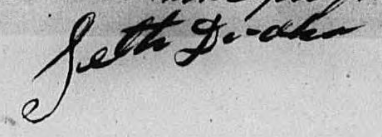
Seth was the oldest son of Abijah and Tabatha Drake, and was born about 1759. After serving in the war, he moved with his family to Vermont. He married Chloe Prentice in 1784, and they had at least five children together. In 1820, he lived next to his father Abijah and his brother Abijah Jr. (my direct ancestor) in Norwich, Vermont. In May 1821, he moved to Allegany County, New York, and died there on July 21, 1821. His father Abijah had died just a few years before on April 7, 1819, in Norwich, Vermont.
Between father and son, their Revolutionary War service reflects two distinct phases of the war. Abijah answered the call in the early days of the war when the army was just being formed and the war was uncertain. As soon as he was old enough, his son Seth enlisted in the established Continental Army a couple years later, during the long difficult middle years of the war. While Abijah’s service was brief, his son’s service was a full three years. Seth was even wounded toward the end of his service, an injury that may have affected him his whole life.
For America’s 250th anniversary, I’m honoring father and son Abijah and Seth Drake of Sutton, Massachusetts, whose Revolutionary War service spanned the founding years of the nation, from Abijah’s early enlistment in 1775 to Seth’s three-year Continental Army service in the struggle for independence.
Selected sources:
- Massachusetts Soldiers and Sailors of the Revolutionary War, 1896, p. 943 and 953-954 (Archive.org)
- Massachusetts Muster Rolls, Vol. 16, Siege of Boston, page 22 (FamilySearch)
- Massachusetts Muster Rolls, Vol. 57, Coat rolls, File 12 (FamilySearch)
- Seth Drake’s Revolutionary War Pension File (National Archives)
- Seth Drake’s Compiled Service Record (National Archives)
- 16th Massachusetts Regimental History (Wikipedia)
- Map images from Library of Congress


